Best Backpacking Water Filters: How to Pick the Right Type for Your Trips
Updated: 2026 | Reviewed by: Chris Mercer
Disclosure: As an Amazon Associate, we earn from qualifying purchases, at no extra cost to you.
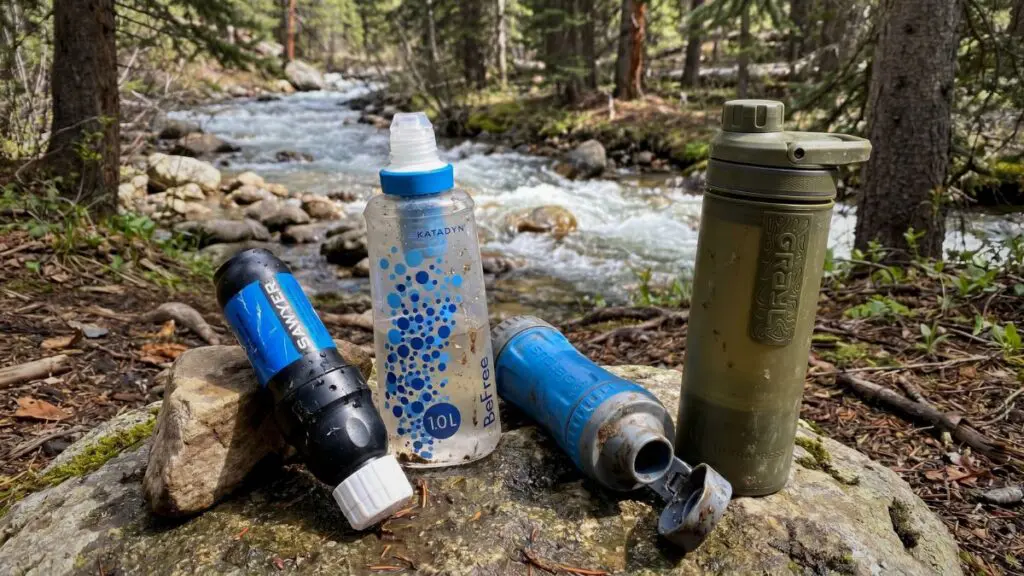
Treating water in the backcountry is non-negotiable, but the filter you carry to do it is one of the more confusing gear decisions out there, mostly because “water filter” covers four completely different tools. A featherweight squeeze filter and a one-pound hand pump both clean your water, but they’re built for different people, different water sources, and different trips.
This roundup sorts eight of the best backpacking water filters by who each one is actually right for, so you can match the format to your trips instead of buying the one with the loudest marketing. Squeeze, gravity, press purifier, hand pump — the picks below cover all four.
My Picks
Best Overall: Platypus QuickDraw
Best Budget: LifeStraw Peak Solo
Best Ultralight: Sawyer Micro Squeeze
Best for Small Groups: Katadyn BeFree Gravity 3L
Best for International Travel: Grayl UltraPress
How to Choose a Backpacking Water Filter
The first decision isn’t a brand, it’s a format. Get the format right and the specific product almost picks itself.
Most backpackers in North America want a squeeze filter, and most of those want one with standard threading. Squeeze filters are light, cheap, and fast: scoop water into a soft bottle or pouch, thread the filter on, and squeeze it into your clean bottle or straight into your mouth. The detail that separates the good ones from the annoying ones is threading. Filters that use standard 28mm soda-cap threads screw directly onto a SmartWater bottle, which means you can refill at any gas station for a buck instead of being locked into a proprietary flask you have to baby. That compatibility is worth more on a long trip than almost any spec on the box. A worthwhile trick most buyers don’t realize: any squeeze filter can also run as a gravity filter by hanging it upside down with a dirty reservoir feeding a clean one, so you don’t necessarily need a dedicated gravity unit to get hands-free filtering at camp.
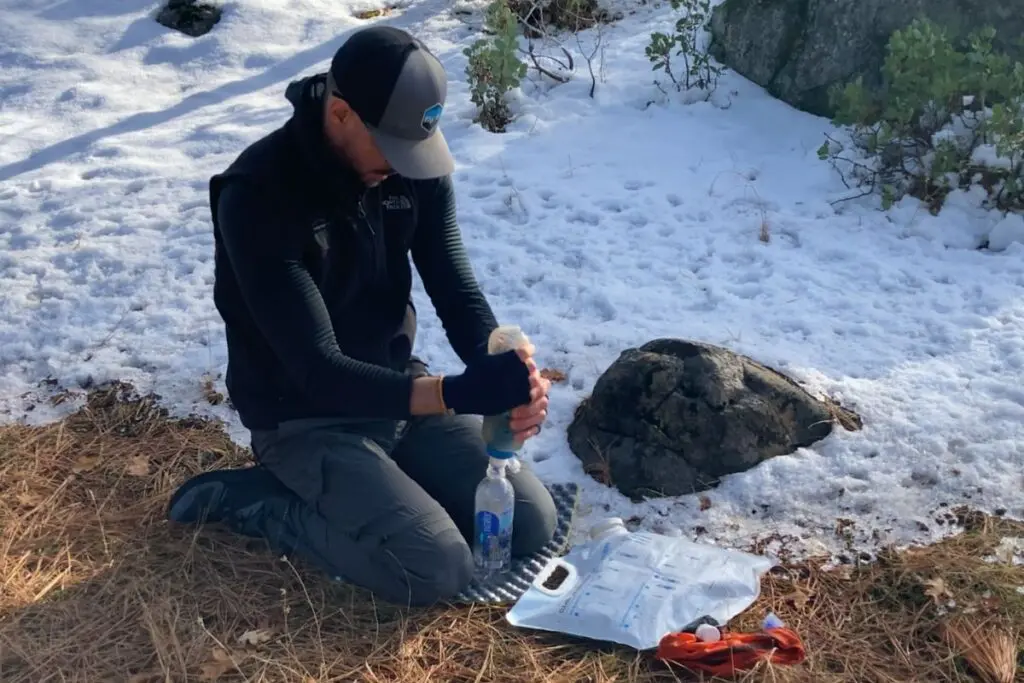
Filtration rating tells you what the filter removes. Hollow-fiber squeeze filters rated to 0.1 or 0.2 micron remove bacteria and protozoa, which is everything you need to worry about in the United States and Canada. None of them remove viruses, because viruses generally aren’t a concern in North American backcountry water. The moment you’re filtering water in regions where viral contamination is a real risk, a standard filter isn’t enough and you need a purifier, which is a different and heavier tool.
Water quality drives the rest. If your sources are clear alpine streams, almost any hollow-fiber filter works and the lightest one wins. If you routinely face silty, tannic, snowmelt, or otherwise cloudy water, sediment clogs hollow-fiber filters fast, and a field-cleanable ceramic pump that you can scrub back to full flow starts looking a lot smarter than a squeeze filter you’ll be backflushing every liter. One reality that applies to every filter here regardless of format: do a pre-trip flow check every time. A filter that performed perfectly on your last trip can be effectively clogged on the next one if it was stored damp or sat too long, and you do not want to discover that at the first water source ten miles in.
The same weekend-warrior load planning that drives your other weekend trip gear applies here: a solo two-nighter and a small-group base camp want different tools, and buying for the trip you actually take beats buying for the trip you imagine.
Best Overall Backpacking Water Filter: Platypus QuickDraw
The Platypus QuickDraw is the squeeze filter to buy if you want one tool that does almost everything well and doesn’t lock you into a proprietary ecosystem. It threads onto SmartWater bottles, Platy bottles, and standard 28mm bottles, runs as a squeeze, gravity, or inline filter, and cleans without any tools, just shake it to restore flow or backflush it tool-free in the field. For most solo and ultralight backpackers, this is the best balance of speed, durability, and flexibility in the squeeze category.
The 0.2 micron hollow-fiber element handles bacteria, protozoa, and microplastics, and the build quality is a genuine step above the budget options, with a reservoir that’s the best in its class. One feature nobody else does as cleanly is the integrity check, which lets you verify the filter is still working after a drop or a freeze, the two things most likely to silently kill a hollow-fiber filter. That’s real peace of mind for a tool your trip depends on.
The honest limitation is the same one that applies to every hollow-fiber squeeze filter: the advertised flow rate is a fresh-filter, ideal-conditions number, and in real use flow drops over time and the filter stays vulnerable to freezing. The QuickDraw doesn’t escape physics, it just manages it better than most. It costs a hair more than the budget benchmark, and it’s worth it.


Not sure what gear you actually need?
Grab the free backpacking checklist I built after 120+ trips. It covers every category so you don’t overbuy or forget something important.
Get the Checklist →Free. No spam. Unsubscribe anytime.
Sawyer Squeeze
The Sawyer Squeeze is the filter the entire squeeze category gets measured against, and it earns that status with the finest filtration rating here and the longest effective lifespan. At 0.1 micron absolute it filters tighter than most competitors, and with regular backflushing the manufacturer rates it for an effectively indefinite life backed by a lifetime warranty. For backpackers who want the proven do-everything standard and plan to keep it for years, nothing else matches the combination of filtration rating and longevity. This is the filter I carry as my primary, and across a lot of trips it’s simply been reliable, which is the only review a water filter really needs to pass.
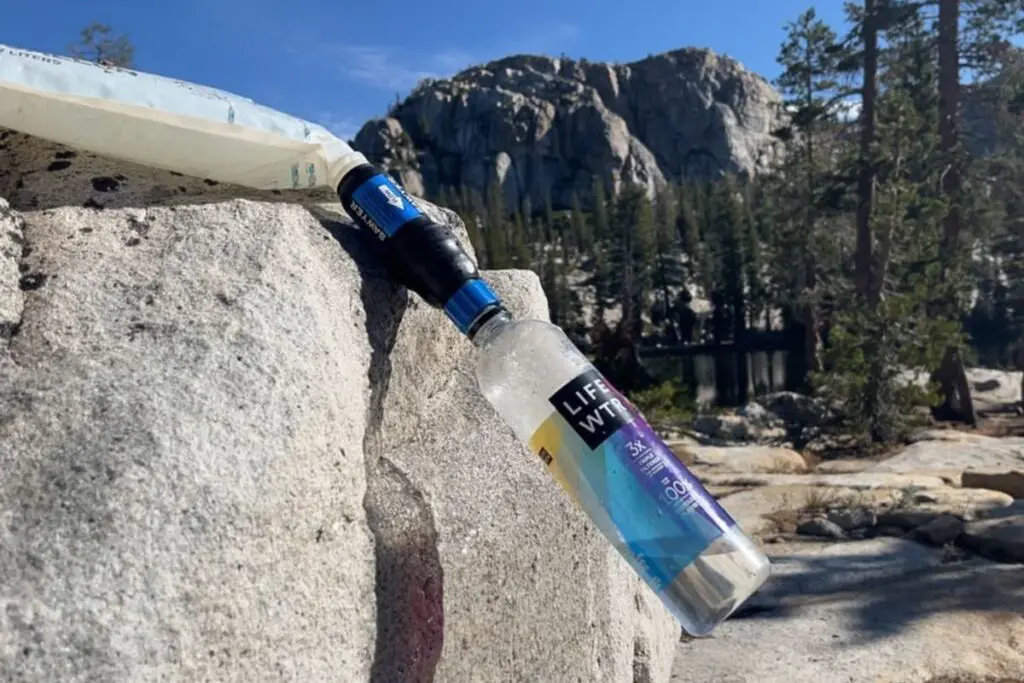
It threads onto standard 28mm bottles and runs inline or as a gravity filter, so it slots into whatever system you already use. The one thing it asks of you is to carry the cleaning syringe, since the syringe backflush is what restores nearly all of the original flow. Flow is good rather than class-leading, and reviewers note it can taper off more noticeably than some newer hollow-fiber designs, so you’ll be backflushing it a bit more often than a QuickDraw or BeFree.
The part of the buying decision people overlook is what you put on the dirty side. The included pouches are the weak point of the whole system; the thin mylar-style bags are known to develop leaks over time and they’re the most common complaint about an otherwise excellent filter. The fix is cheap and worth it: pair the filter with a CNOC Vecto bladder or run it straight off a SmartWater bottle, and the Squeeze goes from “great filter, annoying bag” to a system with no weak link. The Vecto’s wide back opening fills in seconds and doubles as an easy gravity hang; the Vesica bottle is the more packable option if you want something that stands up like a bottle. Buy the filter for its filtration and lifespan, then spend a few dollars to never think about the pouch again.

Best Budget Backpacking Water Filter: LifeStraw Peak Solo
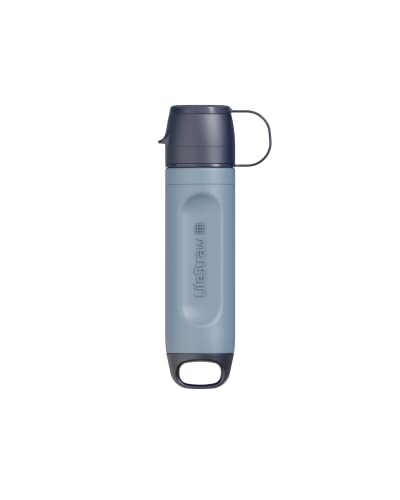
The LifeStraw Peak Solo is the easiest filter on this list to recommend to someone buying their first one, because it’s the lightest, the most compact, and among the most affordable, without giving up the threading compatibility that makes a filter actually usable. At 1.7 oz it disappears into a hip-belt pocket or running vest, and because it threads onto standard 28mm bottles you can run it off the SmartWater bottle you were going to carry anyway. For budget-conscious and ultralight hikers who already carry standard bottles, this is the most filter you can get for the least weight and money.
The 0.2 micron hollow-fiber membrane removes bacteria, protozoa, and microplastics, it drinks as a straw or runs inline, and the rated 2,000-liter lifespan is actually the longest of the squeeze filters here, which is a genuinely impressive number at this price. A backwash syringe comes in the box.
The tradeoffs are the kind you can plan around. It’s too short to drink comfortably straight from a stream, so it really wants a bottle or soft flask to be pleasant to use. And it clogs faster than the premium filters, so it needs more frequent backflushing, the price you pay for the small size and low cost. If you don’t mind staying on top of cleaning, the value here is hard to beat. If you want to fuss with your filter less, one of the pricier picks earns its premium.
Best Ultralight Backpacking Water Filter: Sawyer Micro Squeeze
The Sawyer Micro Squeeze exists for the hiker who wants the full Sawyer Squeeze’s 0.1 micron filtration and near-unlimited cleanable lifespan but refuses to carry a single unnecessary gram. It keeps the finer 0.1 micron absolute rating and the long life in a smaller, lighter 2 oz body, threads onto standard 28mm bottles, drinks via straw, and runs inline or as a gravity filter. If your priority is the tightest filtration and longest life at minimum weight and bulk, this is the pick.
The compromise compared to the full Sawyer Squeeze is flow. The smaller filter body pushes water more slowly, landing well under the fastest hollow-fiber filters here, and that same small body clogs a touch sooner, so backflushing comes around more often. You’re trading some speed and some clog tolerance for size and weight, which is exactly the trade an ultralighter wants to make and a higher-volume user doesn’t. For a solo hiker counting grams, the Micro is the sweet spot of the Sawyer line. For someone filtering a lot of water at camp every night, the full-size filter’s faster flow is worth the extra ounce.

Katadyn BeFree 1.0L
The Katadyn BeFree 1.0L is built around one standout quality: fresh-filter flow that’s among the fastest of any squeeze system here. The wide-mouth 1.0L soft flask fills in a single dunk, the 0.1 micron EZ-Clean membrane needs no syringe (you just shake or swish it to clean), and the 1.0L capacity holds enough for a backpacking refill without constant topping off the way the smaller 0.6L flask does. When it’s working at its best, scooping and drinking on the move is close to effortless, and that fresh-out-of-the-box flow is genuinely faster than a Sawyer Squeeze.
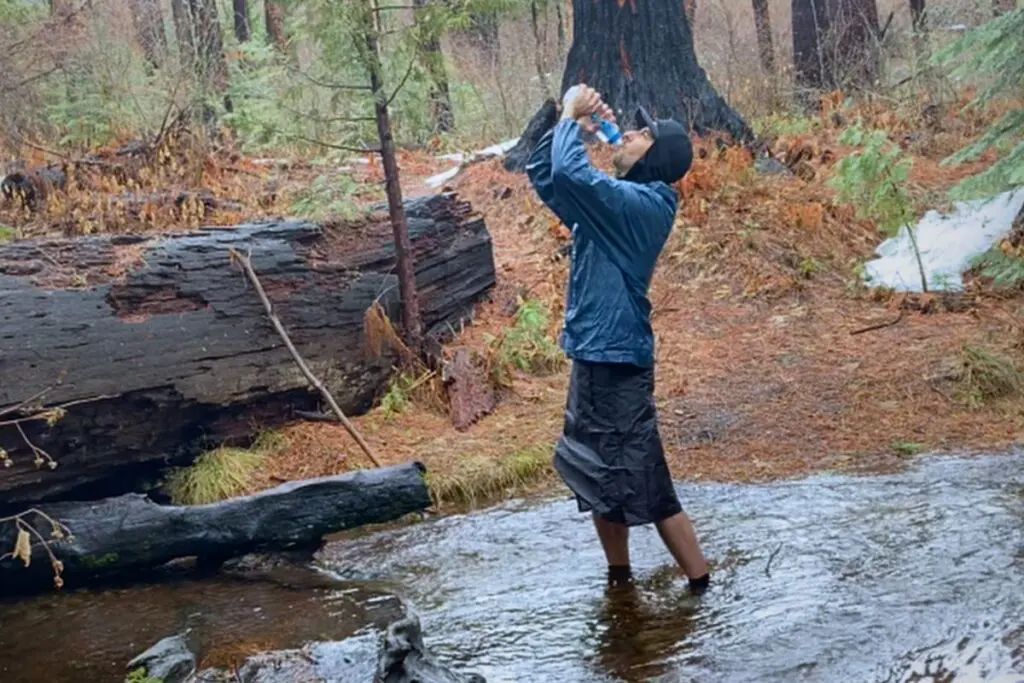
Here’s where I have to be straight, because this is my personal field experience and not universal fact: in my use, the BeFree’s flow drops off fast. After a day or two on trail it filtered at a fraction of its original rate, and the recommended shake-and-swish cleaning did essentially nothing to bring it back. For that reason I don’t personally rely on it as a primary filter, even though the fresh flow is the best in the set. Your results may differ, and plenty of hikers love theirs, but I’d want to know that before buying.
The other limitations are spec-sheet facts. It carries the shortest rated lifespan here at around 1,000 liters, and it’s locked to proprietary 42mm Hydrapak-threaded bottles, so you can’t fall back on a cheap SmartWater bottle the way you can with the Sawyer and LifeStraw filters. The kit flasks are also reported to leak or fail over time, and many owners pair the filter with a sturdier Hydrapak bottle. The BeFree is the right call if maximum fresh-filter flow and tool-free cleaning are what you value most, with eyes open about the lifespan and the proprietary lock-in.

Best Small-Group Backpacking Water Filter: Katadyn BeFree Gravity 3L
The Katadyn BeFree Gravity 3L is the hands-free answer for couples and small groups who are tired of taking turns squeezing bottles. Fill the 3L HydraPak reservoir, hang it from a branch or a trekking pole, and let gravity push water through the 0.1 micron membrane and out the quick-connect hose into bottles, bladders, or a cook pot while you set up camp. For two to four people who want fast camp filtering without the weight or cost of a full 4L or 6L group system, this hits the sweet spot. Flow runs up to 2 L/min, and you can squeeze the reservoir to speed it up.
Cleaning is the simplest in the entire roundup: shake or swish, no syringe, no backflushing tools to lose. The whole kit packs flat when empty and includes the hose, on/off clamp, and hang strap with carabiners that turn it into a true hang-and-walk-away system rather than just a bag with a filter. Being able to fill a cook pot straight off the output hose is a real convenience at a group camp, and it pairs naturally with the kind of setup covered in our weekend backpacking stove guide. It’s worth knowing the plain “BeFree 3L” exists too, but it’s bottle-and-filter only; this Gravity version is the one with the parts that actually make it hands-free.
The downsides mirror the smaller BeFree. The roughly 1,000-liter lifespan is the shortest tier here, and the proprietary 42mm Hydrapak reservoir locks you out of other bottles, so you’re committed to the Katadyn ecosystem. There’s no flow-regulating valve beyond the simple on/off clamp, and the reservoir can be a pain to fully dry between trips, which matters because a damp-stored hollow-fiber filter is exactly the kind that clogs on you. For a solo hiker it’s overkill; for a small group that filters a lot of water at camp, the hands-free convenience is the whole point.

Best Backpacking Water Filter for International Travel: Grayl UltraPress
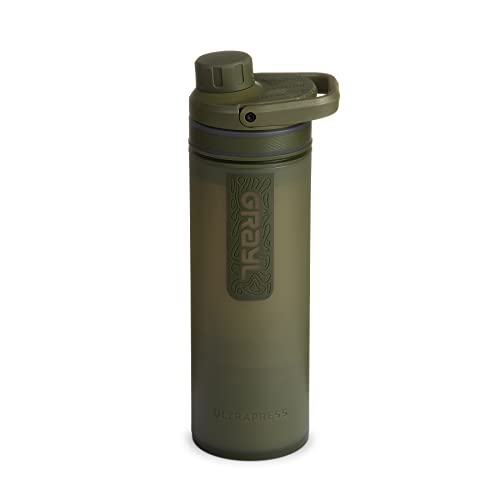
The Grayl UltraPress is the one product here that does something none of the others can: it removes viruses. It’s a press purifier, French-press style, you fill the outer cup with dirty water, press the inner cup down through the cartridge, and drink purified water out the top in about ten seconds. For international travelers and anyone filtering water where viral contamination is a real risk, this is the right tool, full stop, because a standard hollow-fiber filter simply can’t remove viruses and the UltraPress can.
Beyond viruses, the electroadsorption-plus-activated-carbon cartridge removes bacteria, protozoa, microplastics, many chemicals, heavy metals, and PFAS, and it noticeably improves taste and odor, which is no small thing when you’re drinking questionable tap water in a guesthouse. It also tolerates freeze and thaw better than hollow-fiber filters, rated for several cycles. The press-and-drink simplicity is its own selling point: no squeezing, no hanging, no backflushing.
Where it stops making sense is high-volume backcountry filtering. At 12.5 oz it’s by far the heaviest unit here, it treats only 16.9 oz per press, and the cartridge lasts roughly 150 liters, a small fraction of the squeeze filters’ lifespans, and replacement cartridges cost more. That tradeoff is fine for travel and day-to-day drinking and frustrating for a multi-day trip where you’re treating gallons. Buy the UltraPress for travel and virus-risk water, not for filtering a week’s worth of alpine streams.
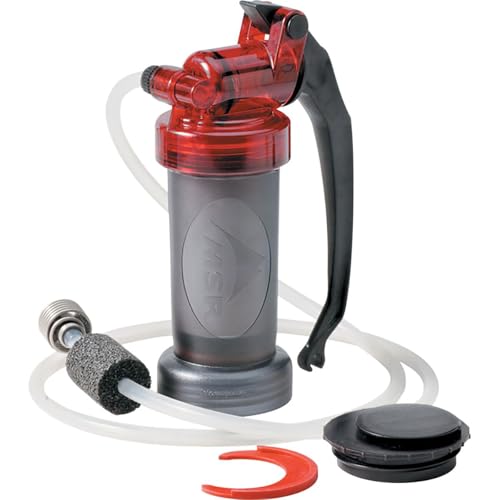
MSR MiniWorks EX
The MSR MiniWorks EX is the filter you carry when the water itself is the problem. Where every squeeze filter on this list clogs on silty, tannic, or snowmelt water, the MiniWorks runs a carbon-and-ceramic element you can unscrew and scrub clean in the field to restore full flow, over and over, which makes it the one tool here that genuinely thrives on cloudy and turbid sources. For hikers who routinely face sketchy water and want a filter they can service on trail instead of replace, this is the rugged answer. The carbon core also pulls out taste, odor, and chemicals, and the whole unit is field-rebuildable with no tools and includes a ceramic wear gauge that takes the guesswork out of when it’s spent.
It threads directly onto wide-mouth Nalgene bottles, and the roughly 2,000-liter lifespan combined with field-cleaning means it can outlast trips that would clog a squeeze filter several times over.
The cost is weight and effort, and it’s not subtle. At a full pound it’s the heaviest filter here, and because it’s a pump you’re working for every liter, around 85 strokes each, with cleaning breaks every few liters when the water’s dirty. For clean alpine water, a modern squeeze filter outclasses it on weight and speed and it’s not close. The MiniWorks isn’t competing to be your lightweight everyday filter, it’s the specialist you bring when the water source would defeat everything else on this list.
The Complete Kit I Use on Every Trip
This post covers one piece of the puzzle. If you want to see everything I actually carry, I keep my full kit documented on one page.
After 100+ trips across the Sierra, the Pacific Coast, and Desert Southwest, this is the setup I’ve dialed in for three-season weekend trips. Same gear, trip after trip. It’s what I’d recommend to anyone building out a dependable kit without overpacking.
The Bottom Line
For most backpackers filtering clear North American water, a squeeze filter with standard threading is the right format, and the Platypus QuickDraw is the best all-around pick, with the build quality, flexibility, and tool-free maintenance to handle nearly any solo or ultralight trip. If you want the proven benchmark with the finest filtration rating and longest life, the Sawyer Squeeze is the do-everything standard, just plan to pair it with a CNOC bladder instead of the flimsy stock pouches. Shaving every gram, the Sawyer Micro Squeeze keeps that same filtration in a smaller body, and on the tightest budget, the LifeStraw Peak Solo gives you the most filter for the least weight and money.
From there it’s about the trip. Filtering for a small group means the Katadyn BeFree Gravity 3L and its hands-free hang-and-fill system. Traveling internationally or facing virus-risk water means the Grayl UltraPress, the only true purifier here. And if your water runs silty, tannic, or snowmelt-cloudy, the MSR MiniWorks EX is the field-serviceable workhorse that keeps going when squeeze filters quit. Match the format to your water and your trip, and any of these will keep you drinking safely.
Related Reading
Amazon and the Amazon logo are trademarks of Amazon.com, Inc. or its affiliates.